SMS Gateway Settings
The SMS gateway is used to send OTP codes and SMS notifications to users (for example, for phone login or order updates). You must configure at least one provider for SMS to work.
What you will set up
- Credentials from your chosen SMS provider (e.g. Account SID, Auth Token for Twilio).
- Admin panel configuration so eDemand can send SMS through that provider.
The table below summarises what you need for each supported provider. Follow the section for your provider to get and enter these values.
| Provider | Credentials you need | Where to get them |
|---|---|---|
| Twilio | Account SID, Auth Token | Twilio Console → API keys & credentials (or main account dashboard) |
| 2Factor.in (TSMS) | API key, Sender ID | 2Factor.in dashboard → API key and Sender ID configuration |
| Fast2SMS | API key, Sender ID, DLT template IDs | Fast2SMS Dev API dashboard; Sender ID and templates from DLT portal |
| MSG91 | Auth key, Flow template IDs | MSG91 Control Panel; Flow templates created in MSG91 dashboard |
Common concepts (all SMS gateways)
Use this section as a quick reference. Each provider section only adds details that are specific to that gateway.
Only one SMS gateway at a time.
eDemand uses one active SMS gateway at a time. When you switch the provider in Settings → SMS Gateway Settings, all OTPs and SMS notifications will go through the newly selected provider.
Where to configure SMS in eDemand
- Open the eDemand admin panel.
- Go to Settings → SMS Gateway Settings.
- Choose your SMS provider by toggling on the status switch.
- Enter the required fields for that provider (see table above and provider sections).
- Avoid mistakes:
- Copy–paste keys exactly.
- Remove any leading or trailing spaces.
- Keep all keys and tokens secret (do not share or store them in code).
Two types of gateways
-
Text-based gateway (no template IDs):
- 2Factor TSMS and Twilio in eDemand works like this.
- eDemand itself builds the final SMS text from its own templates.
- The SMS gateway only receives the full message text (for example in a
Msgfield).
-
Template-based gateways (with template IDs and variables):
- Fast2SMS and MSG91 Flow work like this in eDemand.
- You create and approve templates in the provider / DLT portal.
- Each template gets a template ID (DLT Message ID, Flow ID, etc.).
- In eDemand, each SMS template has:
- a Gateway template ID field (where you put that provider’s template ID), and
- a parameters list (this defines the order of variable values).
Matching variables to the provider template
For template-based gateways, the variable order must match between:
- the placeholders in your provider / DLT template (e.g.
{#var#}, VAR1, VAR2)
and - the parameters list in the matching eDemand SMS template.
Example pattern (both Fast2SMS and MSG91 follow the same idea):
- Template text:
"Your OTP is {#var#}. Valid for 10 min. – {#var#}"or"Your OTP is VAR1. Valid for 10 min. – VAR2". - First placeholder = OTP, second = company name.
- In eDemand, the parameters list for this template must be in the same order, for example:
["otp", "company_name"]. - The app sends values in that order to the gateway.
If the order is wrong, your SMS will show wrong values (for example, company name where the OTP should be).
How to test that SMS is working
After configuring any gateway:
- Make sure the credentials (keys, tokens, Sender ID) are correct and saved.
- If you use phone + OTP login (see Authentication Settings):
- Try logging in using an OTP.
- Confirm that the OTP SMS is received and the text and variables look correct.
- If SMS does not arrive, check:
- credentials and Sender ID,
- template ID / Flow ID / Message ID,
- variable order against the template text,
- any DLT / provider restrictions.
Twilio
Twilio is a popular SMS provider. You will get your Account SID and Auth Token from the Twilio Console, then enter them in the eDemand admin panel.
Using a Twilio trial or test account?
With a trial account, you can only send SMS to verified phone numbers. Add every phone number that should receive OTP or SMS (e.g. test users, support numbers) to your Verified Caller IDs list in the Twilio Console.
For full details, see Twilio’s guide: Get started with your Twilio free trial account (section “Use additional recipient phone numbers”).
Step 1: Open the Twilio Console
- Log in at Twilio Console.
- You will use either your main account credentials (Account SID and Auth Token from the dashboard) or a new API key (recommended for production). Both work for eDemand.
Step 2: Get your Account SID and Auth Token
Option A – Use main account credentials
-
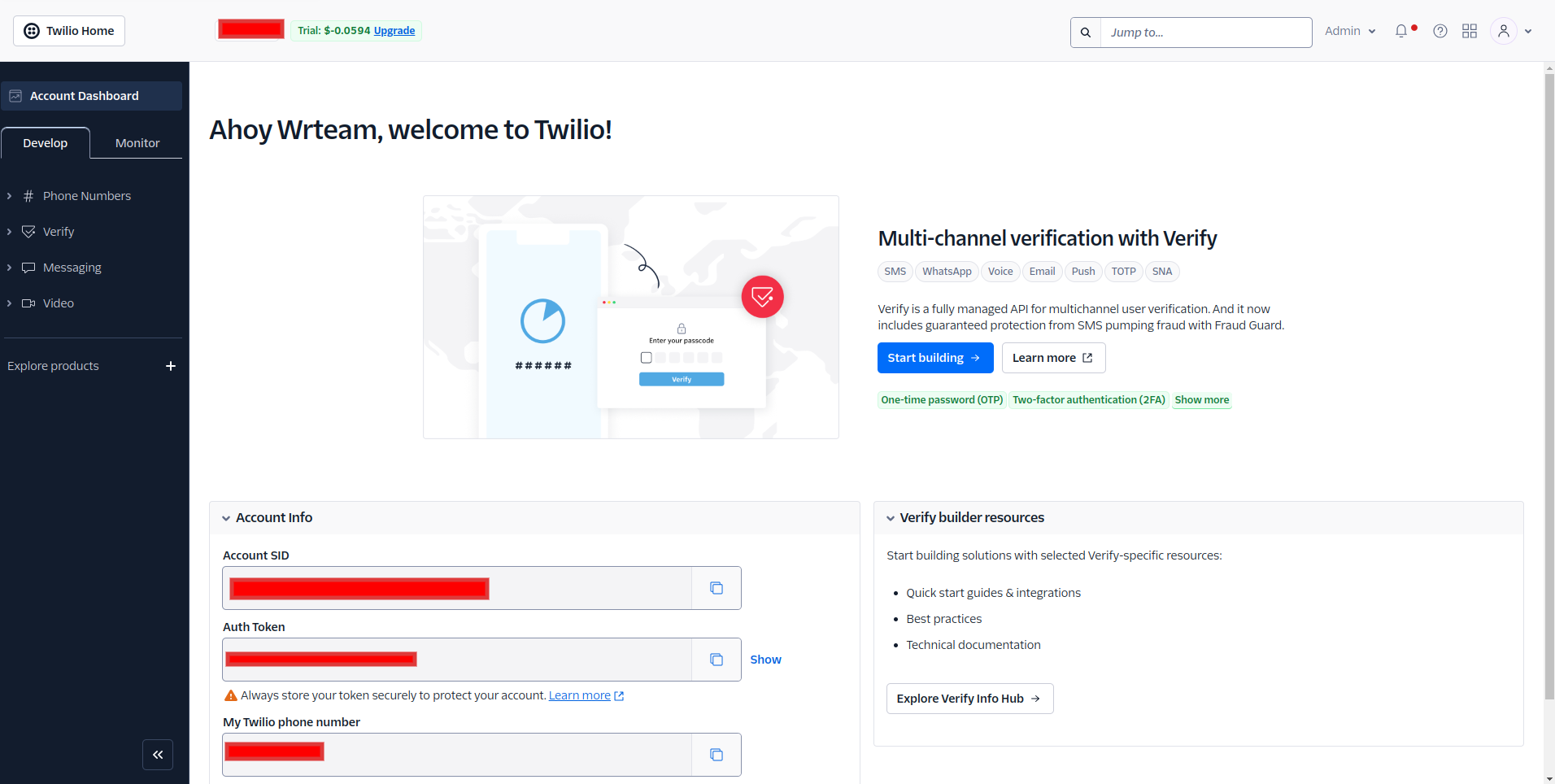
In the Twilio Console dashboard you can find Account SID and Auth Token.
-
Auth Token is hidden by default; click Show to reveal it.
Option B – Create an API key (recommended)
- In the Twilio Console go to Account → API keys & credentials.
- Click Create API key and give it a name (e.g. "eDemand").
- After creating the key, you will see the SID and Secret (this Secret is your Auth Token for this key).
- Copy the Secret immediately — Twilio shows it only once. If you lose it, you must create a new API key.
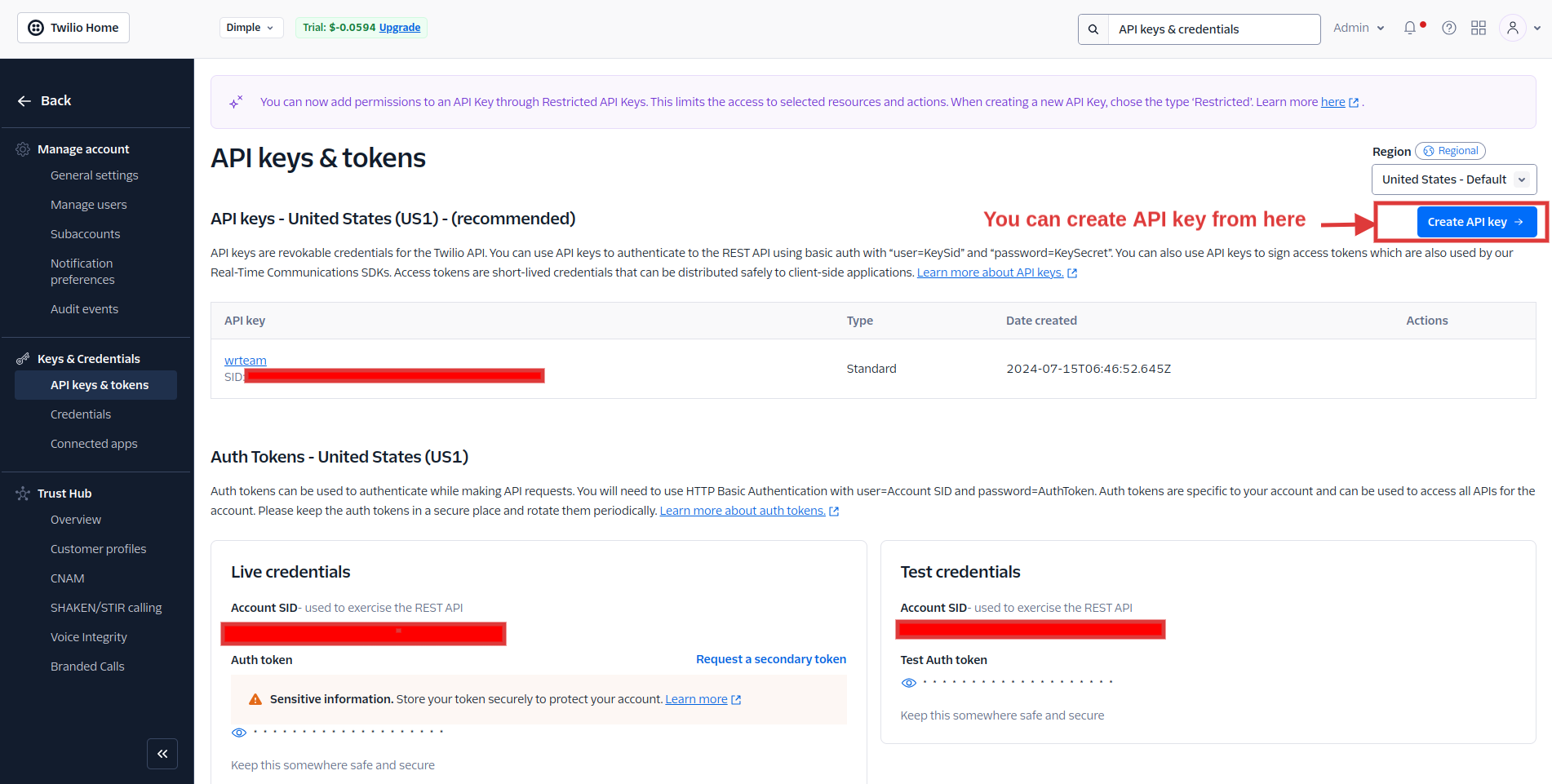
Use the Account SID from the same screen (or from your main account) and the Auth Token (main account token or the Secret from the new API key).
Step 3: Enter credentials in the eDemand admin panel
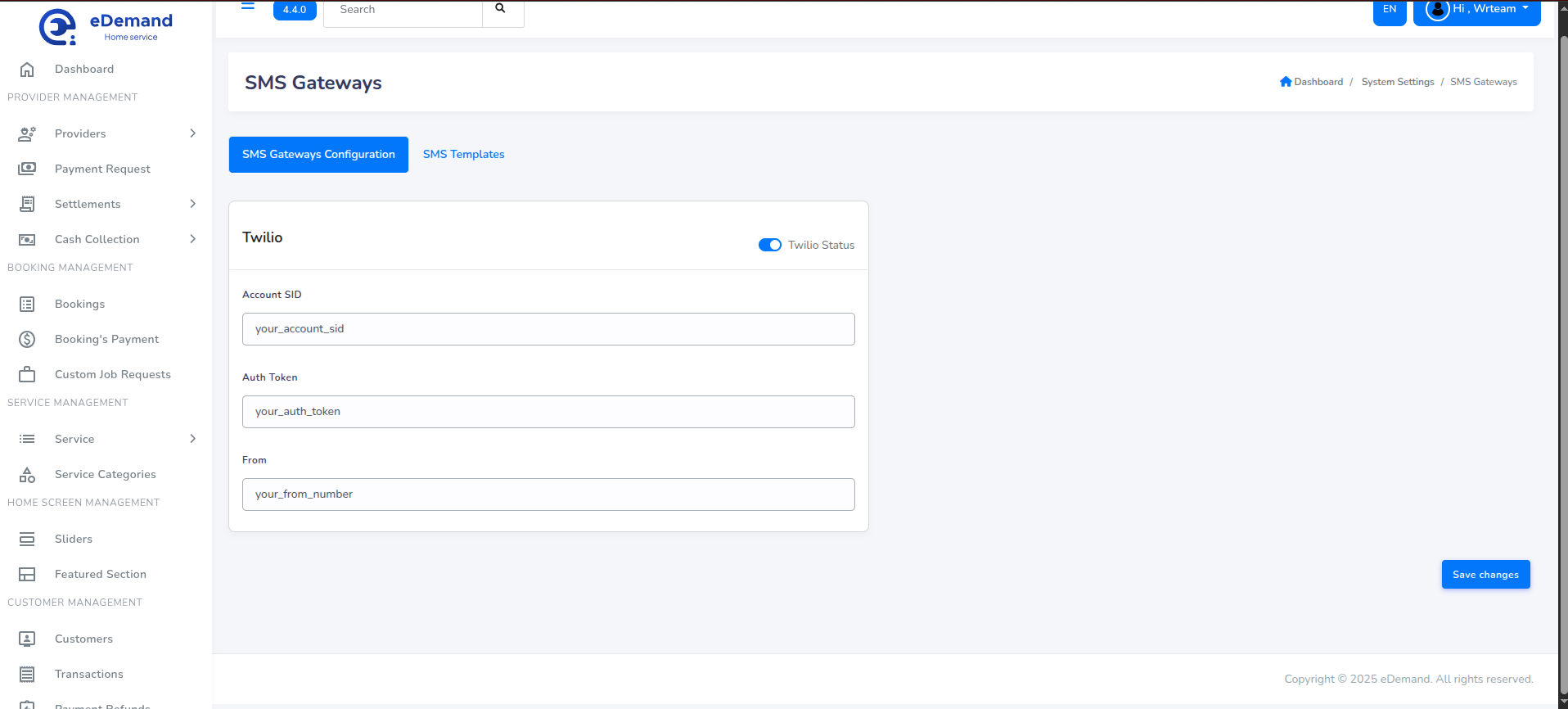
- In the eDemand admin panel go to Settings → SMS Gateway Settings.
- Choose Twilio as the SMS provider.
- Enter the Account SID and Auth Token exactly as shown in Twilio (no extra spaces).
- Save the settings. See Common concepts → Where to configure SMS in eDemand if you need a reminder.
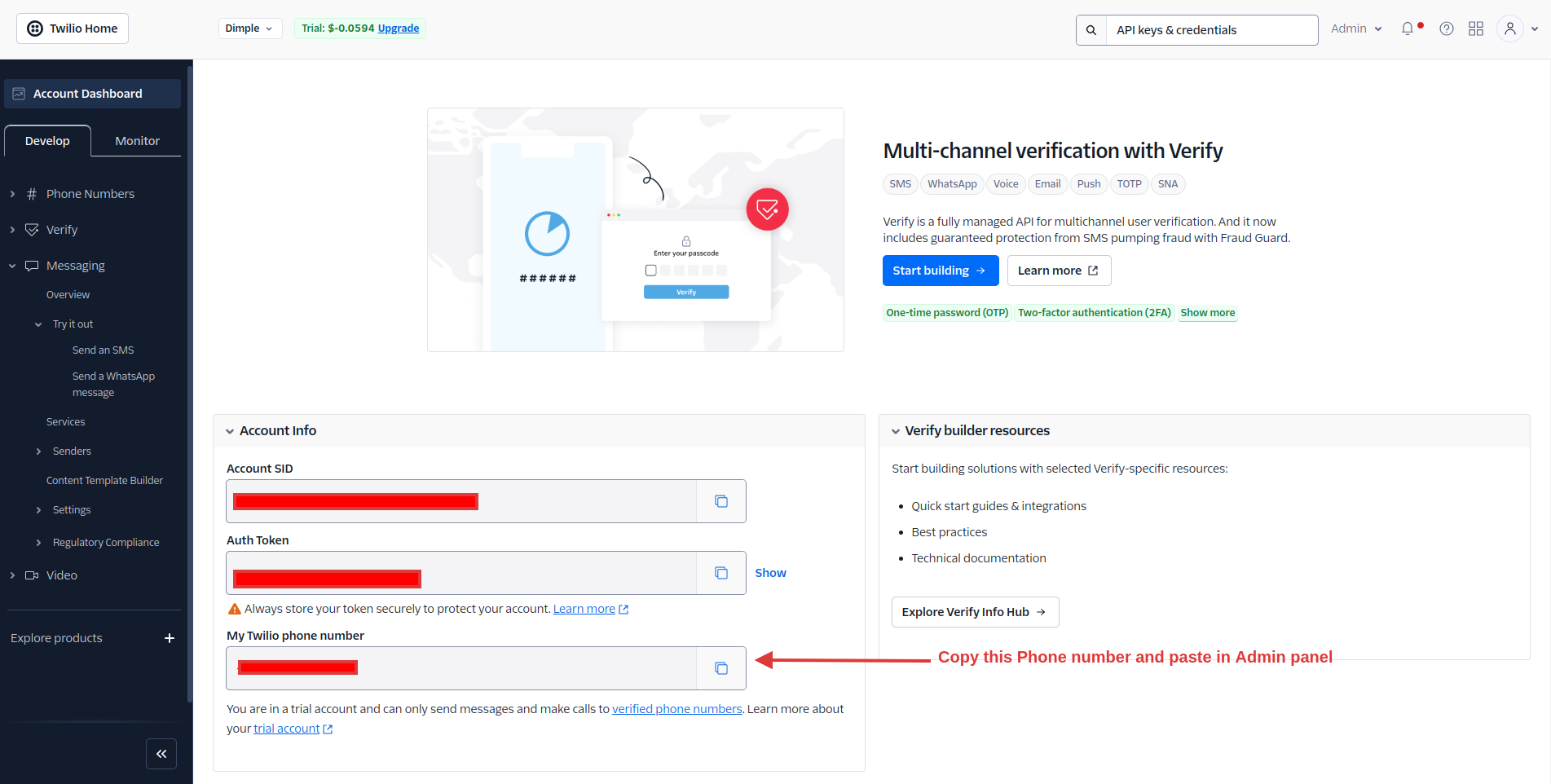
Reference screens from the admin panel:
Step 4: Verify
Follow Common concepts → How to test that SMS is working and send a test OTP / SMS using a real or verified number.
2Factor.in (Transactional SMS – TSMS)
2Factor.in provides a Transactional SMS (TSMS) API that sends SMS using the full message text that eDemand builds from its own SMS templates. Unlike Fast2SMS and MSG91 in this project, 2Factor is not used as a template-based gateway here — there is no DLT/template ID or variable list sent to 2Factor. The app sends the final SMS text directly in the Msg field.
Raw message, no gateway template IDs.
For 2Factor, you configure only the API key and Sender ID in eDemand. The app uses its own SMS templates (inside eDemand) to build the complete message text and sends that text to 2Factor as Msg. You do not configure any "Gateway template IDs" or DLT Message IDs for 2Factor in this app.
What you need for 2Factor
| Item | What it is | Where you get it |
|---|---|---|
| API key | 2Factor API key used in the request URL path. | 2Factor.in dashboard → API keys / account settings. |
| Sender ID | Sender ID shown to the recipient (e.g. 2FACTOR). | 2Factor.in dashboard → Sender / sender ID settings. |
eDemand sends SMS to 2Factor using a POST request to the TSMS endpoint with JSON body: From (Sender ID), To (recipient phone), Msg (full message text). The optional SendAt parameter for scheduling is supported by 2Factor but is not used by this app; SMS are sent immediately.
Step 1: Get your 2Factor API key and Sender ID
- Log in to your 2Factor.in dashboard.
- Find your API key in the account or API section.
- Note your Sender ID (for example,
2FACTOR) that will appear as the sender of SMS. Follow 2Factor’s own rules and any local regulations (for example, DLT in India) when choosing and approving a Sender ID.
Keep your API key secret. Do not share it or commit it in code. Store it only in the eDemand admin panel (Settings → SMS Gateway Settings).
Step 2: Enter 2Factor credentials in the eDemand admin panel
- In the eDemand admin panel go to Settings → SMS Gateway Settings.
- Choose 2Factor (or 2Factor.in / 2factor) as the SMS provider.
- Enter:
- API key — the 2Factor API key from your 2Factor dashboard.
- Sender ID — the Sender ID you configured in 2Factor (for example,
2FACTOR).
- Save the settings, making sure there are no leading or trailing spaces in either field.
Step 3: Verify
Follow Common concepts → How to test that SMS is working and verify that the OTP or notification text looks correct.
For more details on the 2Factor TSMS API itself (parameters, optional fields, and responses), see the official 2Factor docs: https://2factor.in/API/DOCS/ADDON_SRV_SEND_TSMS.html.
Fast2SMS
Fast2SMS is an SMS provider commonly used in India. In India, SMS must follow DLT (Distributed Ledger Technology) rules. This means you cannot send free-form text; you must use pre-approved Sender ID, pre-approved message templates (with a DLT Message ID), and variable values in a fixed order. eDemand is built to work with Fast2SMS in this DLT-compliant way.
India only. Fast2SMS with DLT is intended for sending SMS in India. You need an approved Sender ID and templates on the DLT portal before eDemand can send SMS via Fast2SMS.
What you need for Fast2SMS
| Item | What it is | Where you get it |
|---|---|---|
| API key | Your Fast2SMS authorization key. | Fast2SMS dashboard → Dev API section. |
| Sender ID | A 3–6 letter ID (e.g. FSTSMS). Must be DLT-approved. | Register and get approval in the DLT portal; then use the same ID in Fast2SMS. |
| Template IDs (Message IDs) | One DLT Message ID per SMS type (OTP, booking confirmation, etc.). | Create and approve templates on the DLT portal; each template gets a Message ID. You will enter these in eDemand per template. |
eDemand sends SMS using template ID + variables only. It does not send a custom message body to Fast2SMS. The variable order in eDemand must match the order of placeholders in your DLT template (see below).
Match eDemand templates with DLT.
eDemand has its own SMS templates (e.g. for OTP, booking confirmation). For SMS to work with Fast2SMS, your DLT templates must match these eDemand templates (or you create DLT templates that correspond to them).
When you register a template on the DLT portal, create it for the same event and content as the template in eDemand.
Only SMS types that exist as templates in eDemand will send notifications. If there is no matching template in eDemand for an event, no SMS is sent.
SMS is sent only when certain events occur (e.g. login OTP, order update). Each event uses a specific template. So when registering on DLT, create one approved template per such event and match it to the corresponding template in eDemand (same placeholders and order).
Step 1: Get your API key and Sender ID
- Log in to the Fast2SMS dashboard.
- Open the Dev API section.
- Copy your Authorization Key (API key). You will enter this in eDemand as the Fast2SMS API key.
- Your Sender ID must be DLT-approved (registered in the DLT portal with the same 3–6 letter ID). If you do not have one yet, register and get it approved on the DLT portal first, then use that exact Sender ID in Fast2SMS and in eDemand.
Keep your API key secret. Do not share it or commit it in code. Store it only in the eDemand admin panel (Settings → SMS Gateway Settings).
Step 2: Register DLT templates and get Message IDs
For each kind of SMS you will send (e.g. OTP, booking confirmation), you need a DLT-approved template. Create a DLT template for each SMS template that exists in eDemand for the events you use (e.g. OTP login, booking confirmation). Only those events that have a matching template in eDemand’s SMS templates will trigger an SMS.
- In the DLT portal, create a template with the text you want to send (matching the content and variables of the corresponding eDemand template).
- Use placeholders where values will change (usually written as
{#var#}). Order matters — this order must match the parameters list in the corresponding eDemand template (see Common concepts → Matching variables to the provider template). - Submit the template for approval and note the Message ID (template ID) assigned to it.
You will enter each template’s Message ID in eDemand when configuring that SMS template (see Step 4).
Step 3: Enter Fast2SMS credentials in the eDemand admin panel
- In the eDemand admin panel go to Settings → SMS Gateway Settings.
- Choose Fast2SMS as the SMS provider.
- Enter:
- API key — the Authorization Key from the Fast2SMS Dev API dashboard.
- Sender ID — your DLT-approved 3–6 letter Sender ID (e.g. FSTSMS).
- Save the settings.
Ensure there are no leading or trailing spaces in the fields.
Step 4: Add the DLT template ID for each SMS template
eDemand has built-in SMS templates (e.g. for OTP, booking notifications). For each one you use with Fast2SMS, set the Gateway template ID (Fast2SMS) to the DLT Message ID of the matching template.
- In the admin panel, open where SMS templates or Gateway template IDs are configured (usually under notification or SMS template settings).
- For each SMS type (e.g. OTP, booking confirmation), find the Fast2SMS or Gateway template ID field.
- Enter the Message ID from the DLT portal for that template.
- Save.
The app sends this Message ID to Fast2SMS as the message parameter (template identifier). It does not send the raw SMS text.
Step 5: Match variable order (parameters) with your DLT template
Each DLT template has placeholders {#var#} in a fixed order. eDemand sends the values for these placeholders as pipe-separated values in the same order.
- In eDemand, each SMS template has a parameters list (e.g.
["otp", "company_name"]). This defines the order of values sent to Fast2SMS. - The first parameter in the list is the value for the first
{#var#}in the DLT template; the second parameter is the value for the second{#var#}, and so on. - Example:
- DLT template:
"Your OTP is {#var#}. Valid for 10 min. – {#var#}"(first var = OTP, second = company name). - In eDemand, parameters should be in the same order, e.g. otp, company_name.
- Values sent to Fast2SMS:
variables_values=6695|MyStore(OTP|company name).
- DLT template:
If the order in eDemand does not match the order of {#var#} in the DLT template, the SMS will show wrong values. Check your DLT template and the template configuration in eDemand so the orders match.
Step 6: Verify
- Ensure API key and Sender ID are correct and have no extra spaces.
- For each SMS type you use, ensure the Gateway template ID (Fast2SMS) equals the DLT Message ID of the approved template and that the parameter order is correct.
- Follow Common concepts → How to test that SMS is working (for example, by testing phone + OTP login).
For more on the Fast2SMS DLT API, see the Fast2SMS API reference (DLT SMS GET API).
MSG91
MSG91 is an SMS provider that supports the Flow API: you send SMS using pre-defined templates and variables (VAR1, VAR2, VAR3, …) instead of free-form message text. eDemand uses this template-based flow so that OTP and other notifications are sent via your MSG91 Flow templates.
Template-based sending. With MSG91, eDemand does not send raw message text. It sends a template ID and variable values in a fixed order. Your MSG91 Flow template placeholders (VAR1, VAR2, …) must match the order of parameters in eDemand’s SMS templates.
If you send SMS in India via MSG91, your Flow templates must comply with DLT (Distributed Ledger Technology) rules. You must:
- Register your entity (Principal Entity) and get your Sender ID (header) approved on the DLT platform.
- Create and get content templates approved on the DLT platform (same as for other Indian SMS gateways).
- In the MSG91 panel, map each approved DLT Template ID to the corresponding Flow ID for that template.
SMS will not be delivered in India until DLT approval is in place and the DLT Template ID is mapped to your Flow template on MSG91. See MSG91’s help: Map approved DLT Template Id with Flow Id and DLT FAQs.
What you need for MSG91
| Item | What it is | Where you get it |
|---|---|---|
| Auth key | Your MSG91 authentication key. | MSG91 Control Panel (control.msg91.com) — used as the authkey header when sending. |
| Flow template ID | One template ID per SMS type (OTP, booking confirmation, etc.). | Create a Flow template in the MSG91 dashboard; each template gets an ID. You enter this ID in eDemand per SMS template (Gateway template IDs → MSG91). |
eDemand sends SMS using template_id + recipients (phone + VAR1, VAR2, …). The order of variables in eDemand must match the order of placeholders (VAR1, VAR2, VAR3, …) in your MSG91 Flow template.
Match eDemand templates with MSG91 Flow templates.
eDemand has built-in SMS templates (e.g. for OTP, booking confirmation). For SMS to work with MSG91, you must create Flow templates in MSG91 that correspond to these events and set the Gateway template ID (MSG91) in eDemand to the Flow template ID.
The variable order in the app (template parameters) is mapped to VAR1, VAR2, VAR3, … in the API. So the first parameter in eDemand = VAR1, the second = VAR2, and so on. Your MSG91 Flow template placeholders must be in the same order.
Step 1: Get your Auth key
- Log in to the MSG91 Control Panel.
- Find your Auth Key (authentication key) in the dashboard or API section.
- Copy the key. You will enter it in eDemand under Settings → SMS Gateway Settings as the MSG91 Auth Key.
Keep your Auth key secret. Do not share it or commit it in code. Store it only in the eDemand admin panel (Settings → SMS Gateway Settings).
Step 2: Create Flow templates in MSG91 and get template IDs
For each kind of SMS you will send (e.g. OTP, booking confirmation), you need a Flow template in MSG91. Create one Flow template for each SMS template that exists in eDemand for the events you use.
- In the MSG91 dashboard, create a Flow template with the text and placeholders you need.
- Use MSG91’s placeholders VAR1, VAR2, VAR3, … in the order you want. Order matters: VAR1 = first value from eDemand, VAR2 = second, etc.
Variable names must be in capital letters. Use VAR1, VAR2, VAR3 (uppercase) in your Flow template. Lowercase names (e.g. var1, var2) may not be replaced correctly by the API. Match the exact naming used in MSG91’s Flow template editor for variable replacement to work.
- Note the template ID assigned to the Flow template. You will enter this in eDemand as the Gateway template ID for that SMS type (Step 4).
Example:
- Flow template text: "Your OTP is VAR1. Valid for 10 min. – VAR2" (VAR1 = OTP, VAR2 = company name).
- In eDemand, the parameters for this template must be in the same order: e.g.
otp, thencompany_name, so that the app sends VAR1 = OTP, VAR2 = company name.
Step 3: Enter MSG91 credentials in the eDemand admin panel
- In the eDemand admin panel go to Settings → SMS Gateway Settings.
- Choose MSG91 as the SMS provider.
- Enter the Auth Key — the authentication key from the MSG91 Control Panel.
- Save the settings.
Ensure there are no leading or trailing spaces in the Auth Key field.
Step 4: Add the Flow template ID for each SMS template
eDemand has built-in SMS templates (e.g. for OTP, booking notifications). For each one you use with MSG91, you must set the Gateway template ID for MSG91 to the Flow template ID from your MSG91 dashboard.
- In the admin panel, open the place where SMS templates or Gateway template IDs are configured (usually under notification or SMS template settings).
- For each SMS type (e.g. OTP, booking confirmation), find the MSG91 or Gateway template ID field.
- Enter the Flow template ID from the MSG91 dashboard for that template.
- Save.
The app sends this template ID to MSG91 in the request body as template_id, along with recipients (phone and VAR1, VAR2, …).
Step 5: Match variable order (parameters) with your MSG91 Flow template
Each MSG91 Flow template has placeholders VAR1, VAR2, VAR3, … in a fixed order. eDemand sends values as VAR1, VAR2, VAR3, … in the same order as the template’s parameters in eDemand.
- In eDemand, each SMS template has a parameters list (e.g.
["otp", "company_name"]). The first parameter is sent as VAR1, the second as VAR2, and so on. - Example:
- MSG91 Flow template: "Your OTP is VAR1. Valid for 10 min. – VAR2" (VAR1 = OTP, VAR2 = company name).
- In eDemand, parameters should be in the same order: otp, company_name.
- The app sends:
recipients=[{ "mobiles": "919876543210", "VAR1": "6695", "VAR2": "MyStore" }].
If the order in eDemand does not match the order of VAR1, VAR2, … in the MSG91 Flow template, the SMS will show wrong values. Check your Flow template and the template configuration in eDemand so the orders match.
Step 6: Verify
- Ensure the Auth Key is correct and has no extra spaces.
- For each SMS type you use, ensure the Gateway template ID (MSG91) equals the Flow template ID from the MSG91 dashboard.
- Confirm that template parameters in eDemand are in the same order as VAR1, VAR2, VAR3, … in the MSG91 Flow template.
- If you use phone + OTP login (see Authentication Settings), try logging in using the OTP sent via the MSG91 SMS gateway to confirm SMS is delivered.
For more on the MSG91 Flow API (endpoint, request body, and response), see the MSG91 Flow API documentation.